 No. 1 · Techno ·
The heart of the movement
A watch stops eight times a second. That is why it runs.
The mainspring in a movement strains to let go all at once. One assembly stops it – the lever escapement. It holds the wheels of the train and releases them exactly one step at a time, and with every step it also gives the balance a push so that it does not stop.
The wheel turns 4 times slower than in the watch
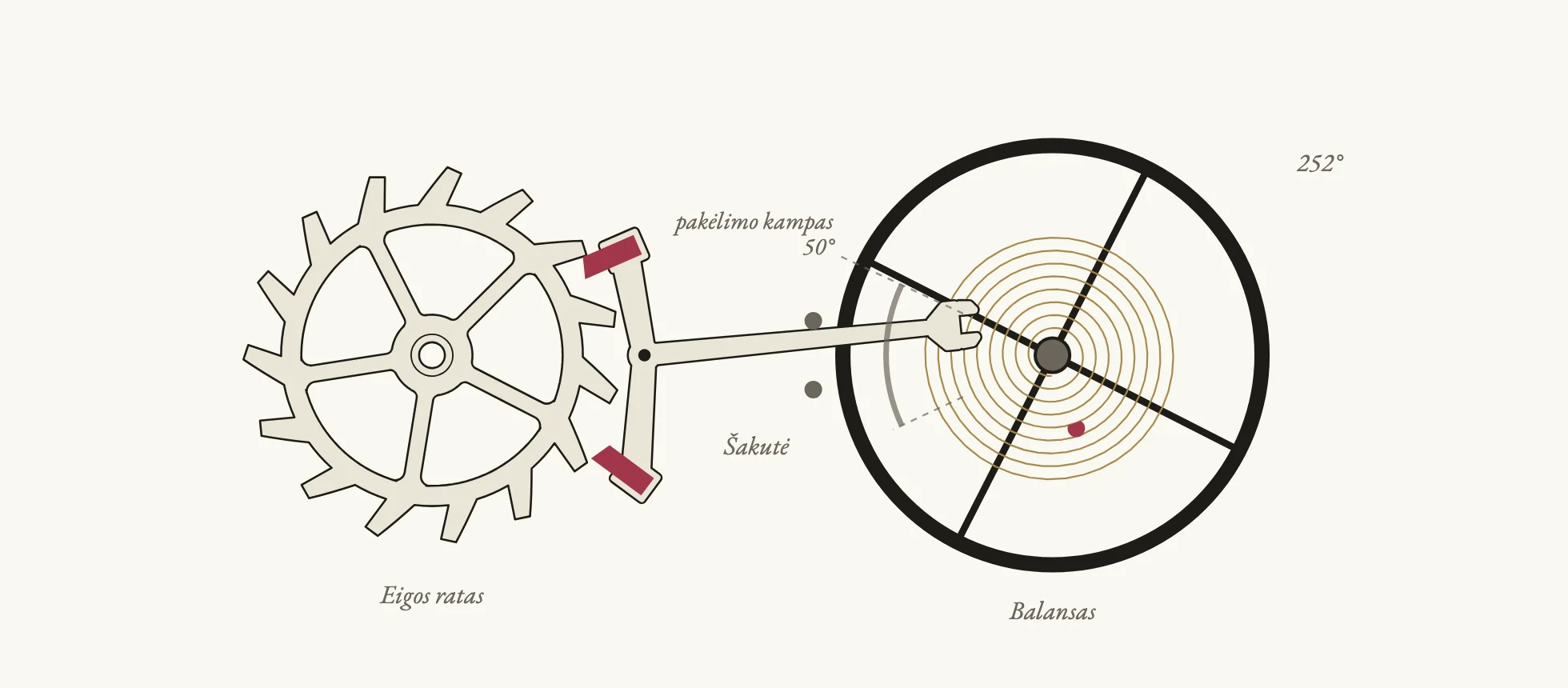
Fig. 1 · The Swiss lever escapement
Five movements in one beat
Everything you see in the diagram happens within one beat. Most modern watches beat eight times a second. As the balance sweeps through the middle, the escapement performs five actions – they are highlighted in the diagram as they happen:
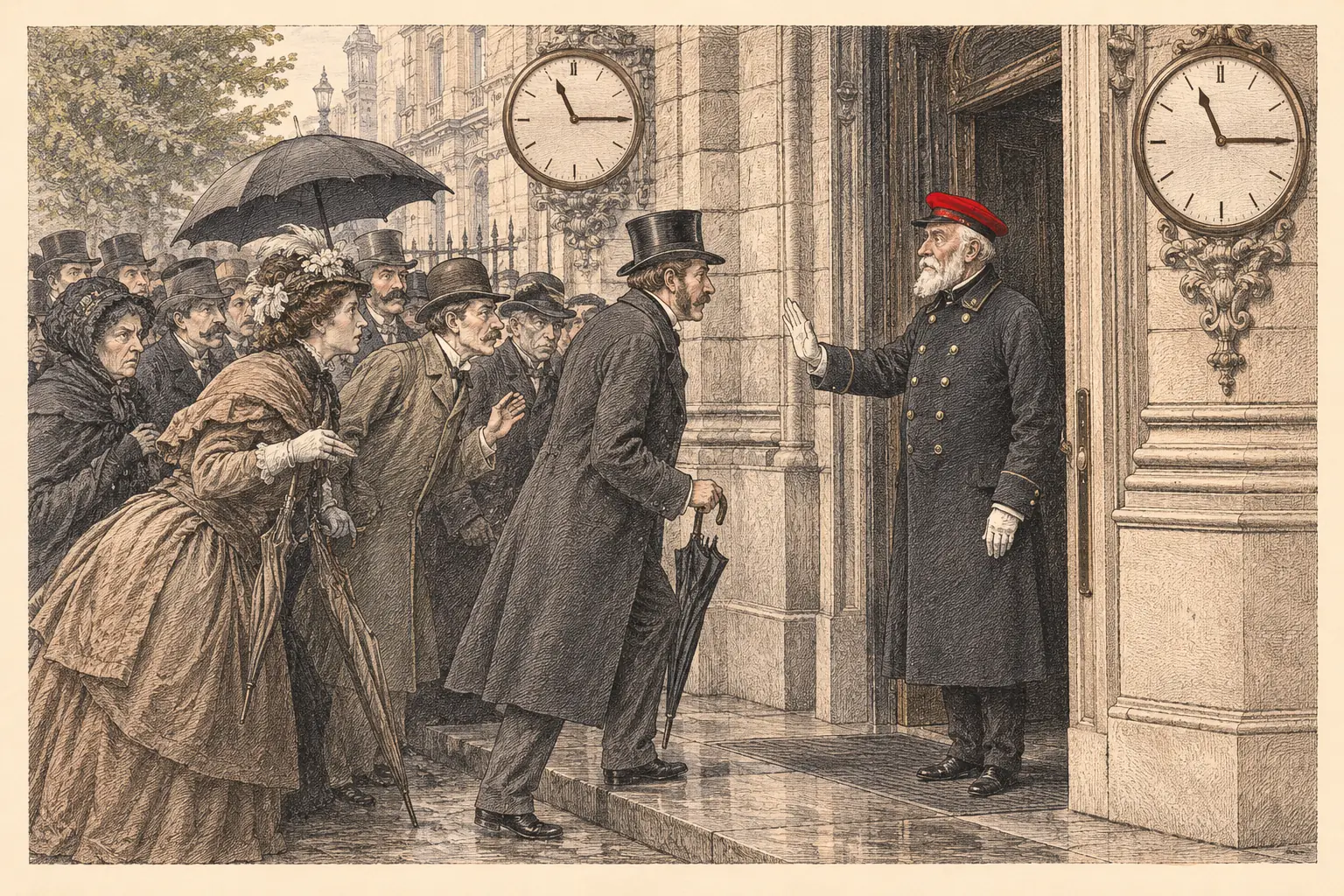
The escapement is like a patient doorman. Behind the door the mainspring’s whole energy is pushing, and he lets it in one at a time – and only when the balance waves its hand.1
- LockingAn escape wheel tooth rests on a pallet. The wheel stands still, and with it the whole train back to the mainspring.
- UnlockingThe balance’s impulse jewel catches the lever and turns it slightly. The pallet moves away, and the tooth is freed.
- ImpulseThe tooth slides along the pallet’s impulse face and pushes the lever, and the lever, through the impulse jewel, pushes the balance. That is how the balance gets energy for the next swing.
- DropThe tooth slips off the pallet, and the wheel turns freely through a small angle until the next tooth lands on the other pallet.
- DrawThe tooth’s pressure draws the pallet deeper, and the lever is pressed against the banking pin. The balance swings on completely free.
For most of the time the balance does not touch the escapement at all: it swings freely, and the train stands still.2
That is the secret of accuracy. The balance with its hairspring can be seen as a small pendulum whose period is set by its own properties. The less the escapement touches it, the less it changes its rhythm. This ideal is called isochronism: the period of the swing should not depend on how much energy the balance received. No escapement is fully isochronous; designers only try to make the impulse change the period as little as possible.
Fig. 2 · Isochronism: two balances, different swings
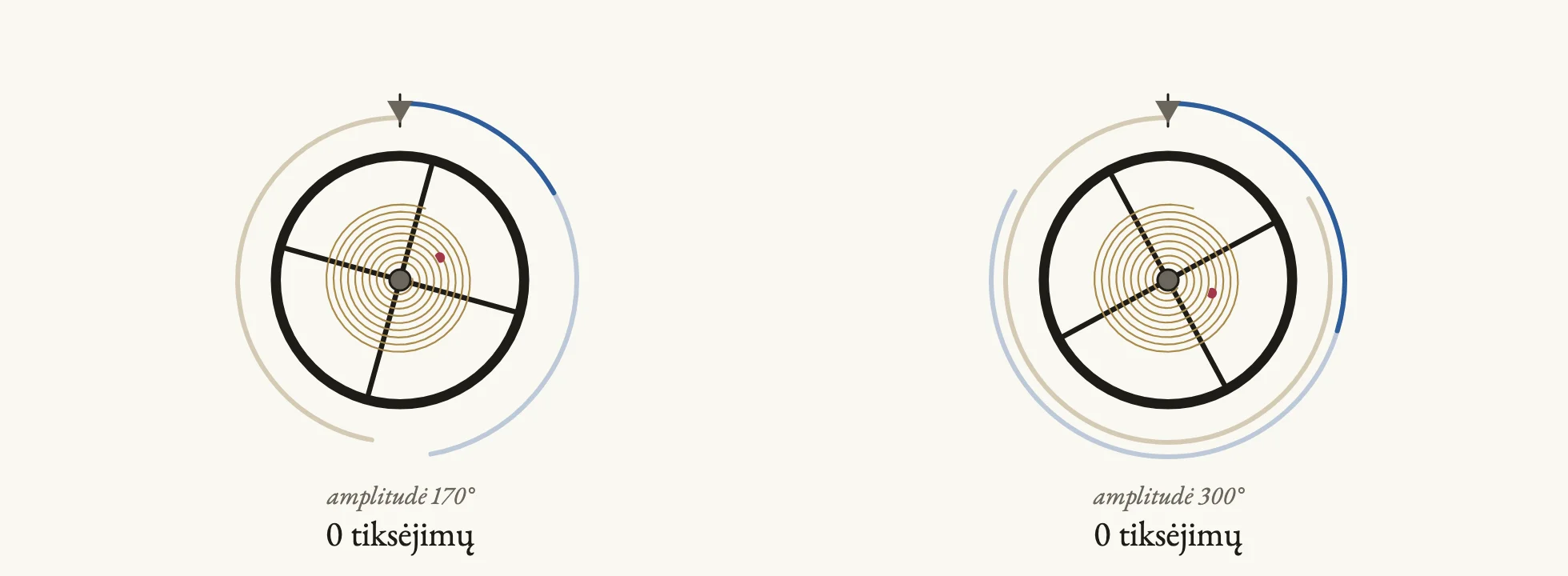
Ideally the period of the swing does not depend on its size: both balances pass the middle together. In “Real” mode the deviation is greatly exaggerated so that it can be seen within a few seconds; its true size depends on the particular movement.
Fig. 3 · A knock to the wrist
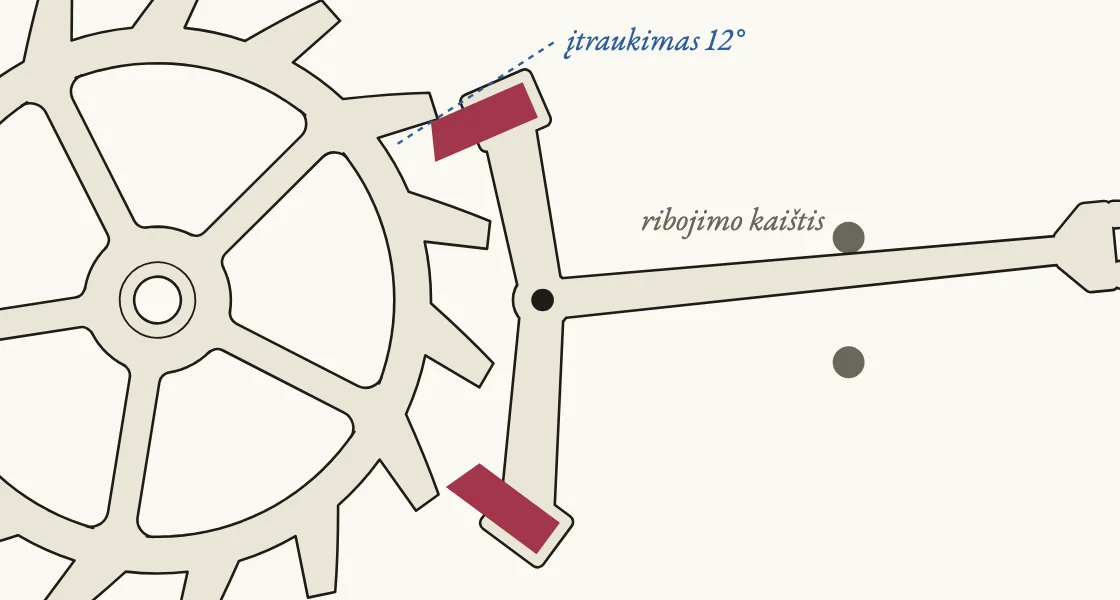
Press “Knock”: the watch takes a blow, for example when the wrist hits a table.
Why that small angle matters
The lever is not fixed. Between beats it is the escape wheel itself that presses it against the banking pin: the pallet face is inclined, usually 11–15°, so the tooth’s force draws the pallet deeper. This angle is called draw. Without it a sudden knock could unlock the escapement and the wheel would slip.
The reliability of the modern lever escapement rests on this angle.
A number you can see
A watch’s frequency is measured in beats per hour. 28,800 sounds abstract, but it is simply eight small steps of the seconds hand per second. Below are all the usual frequencies side by side. Slow them down and you will see what the eye cannot catch: eight steps per second, or twelve.
Fig. 4 · The seconds hand at each frequency
What beats at 36,000 and 43,200
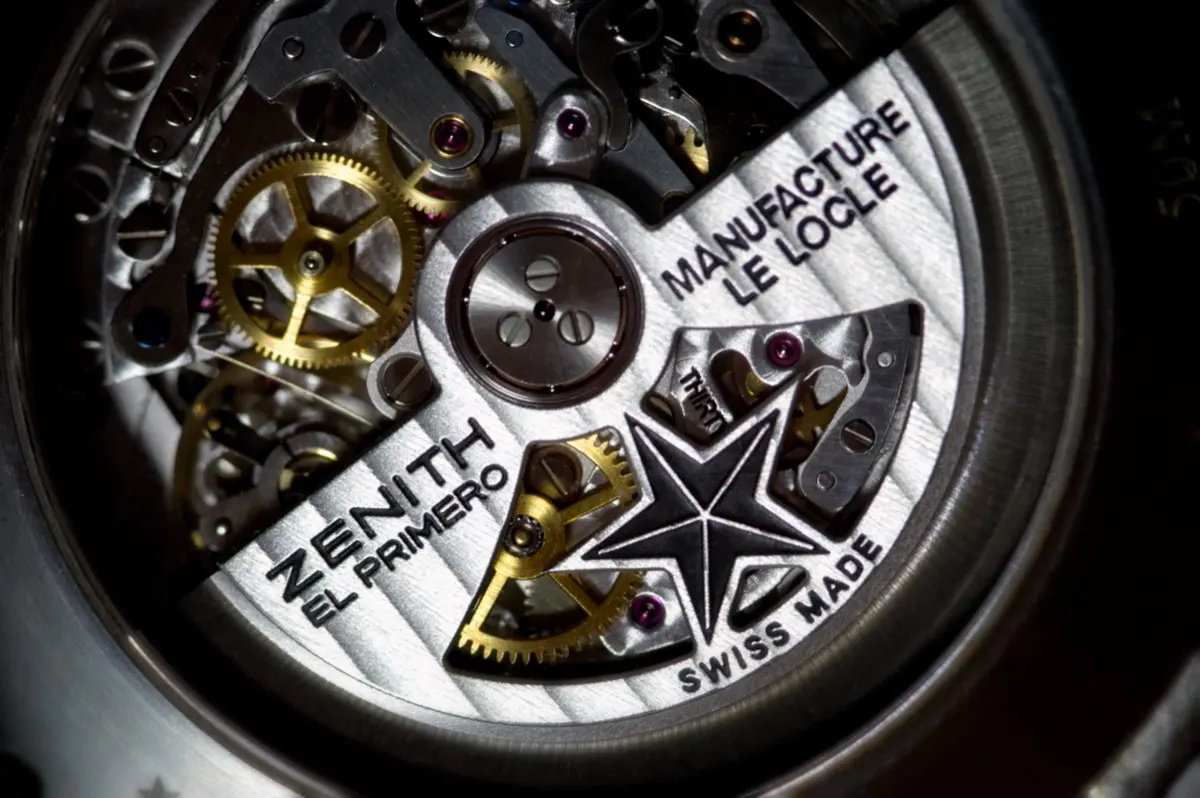 36,000 · 5 Hz
Zenith El Primero
Presented on 10 January 1969 – the first high-frequency automatic chronograph movement.
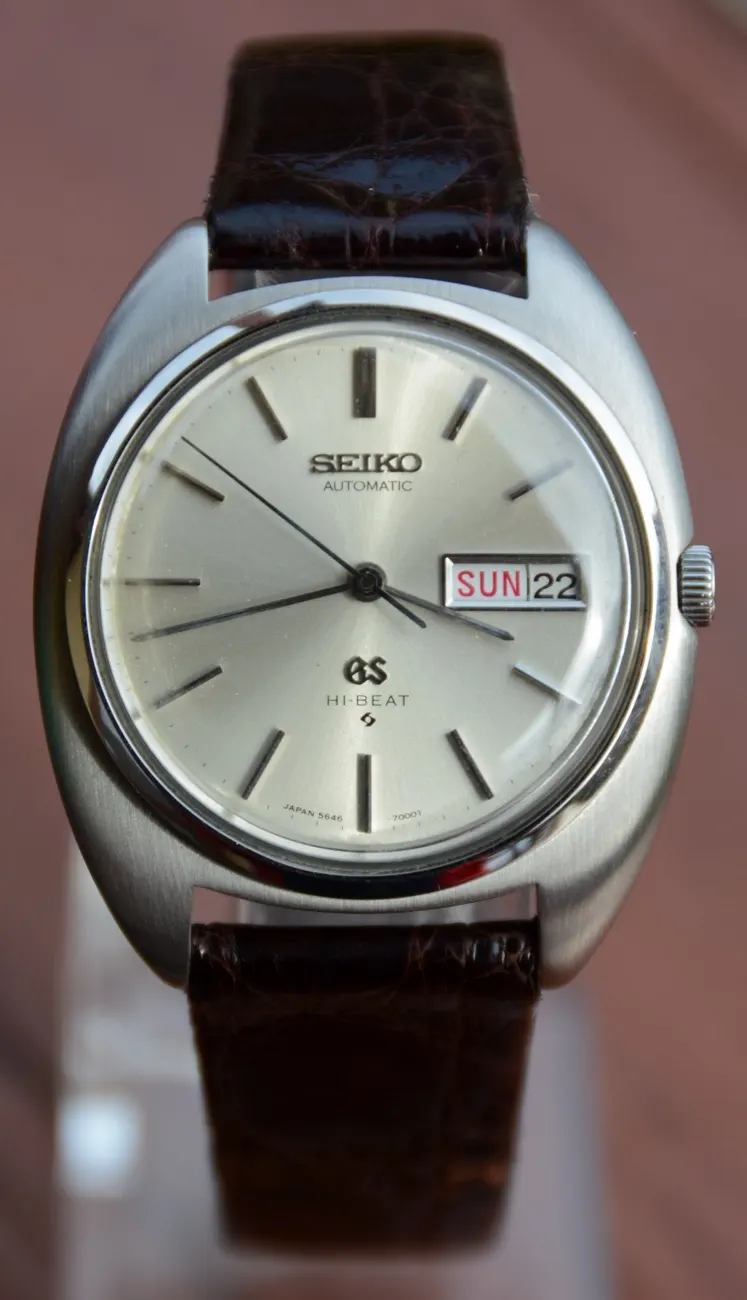 36,000 · 5 Hz
Grand Seiko Hi-Beat 36000
Grand Seiko’s first new high-frequency movement in about 40 years. Power reserve: about 55 hours.
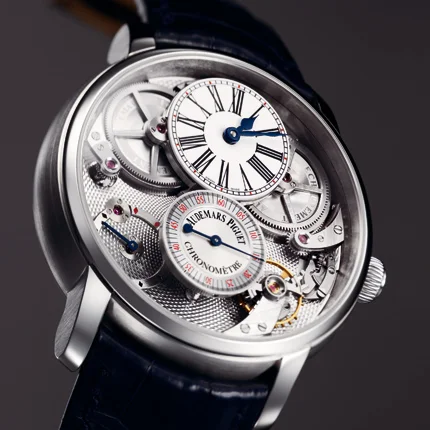 43,200 · 6 Hz
Audemars Piguet Jules Audemars Chronometer
With its own “Audemars Piguet escapement”, presented in 2006. Platinum, 46 mm, 72-hour reserve; price CHF 316,500.
Beats and hertz
Makers write the frequency in two ways, and it is the same number. A beat is one half-oscillation of the balance, while hertz count full oscillations, each made of two beats.
Why does the frequency go up? A faster-swinging balance feels the movements of the arm less, so precise watches get a faster one.
Still, this is no endless race: the working frequency of most modern mechanical watches stays at 3–4 Hz. Only a few beat faster – 5 Hz can still be found, while 6 Hz, or 43,200 beats an hour, is a rarity – like the Audemars Piguet watch we described next to Fig. 4.
A turn and a half per beat
The balance does not swing modestly. From its rest point it turns about 270° to each side, so in one beat, from one extreme to the other, it travels about 540° – a turn and a half. And so on without a pause, day and night. This angle is called the amplitude.3
- You can try it yourself: turn round one and a half times one way, then the other, eight times a second. After the first second you will want to sit down; the balance works like this for years. ↩
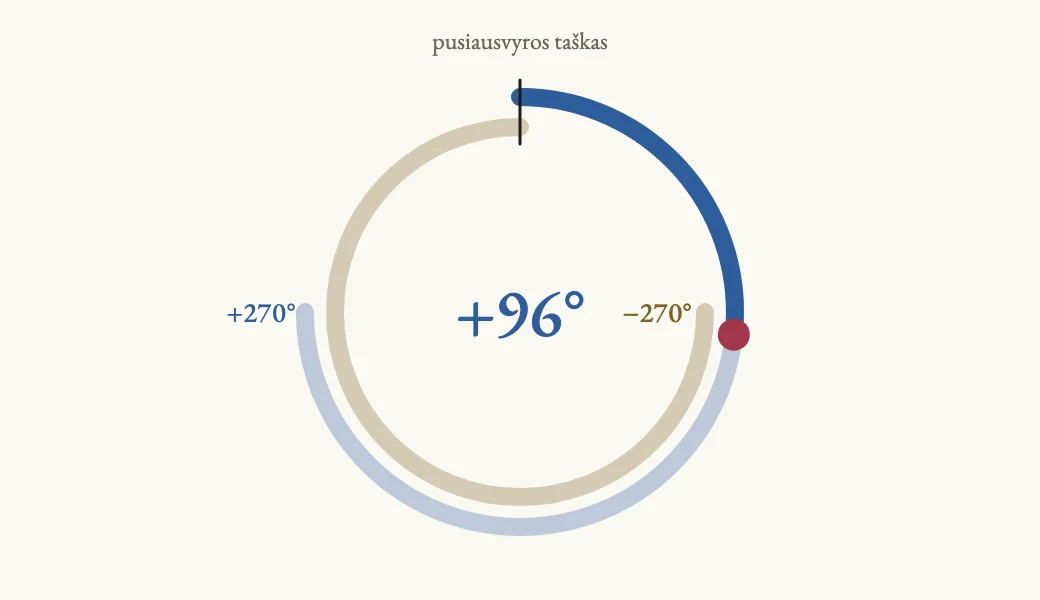
Fig. 5 · Amplitude, 270° to each side
The marker shows one point on the balance. The blue arc is its path to one side, the gold arc to the other. Each is 270°: that is the amplitude. Together, 540° – a turn and a half. In a real watch this takes 1/8 of a second; here it is 20 times slower.
Why 180° is already a full circle
Amplitude is counted from the rest point to one side only. If the balance turns 180° one way and 180° the other, a point on it traces a full circle. So the usual 270–315° amplitude means that in one beat the balance travels 540–630°. At 360° it makes a full turn in each direction, and the impulse jewel reaches the lever from the other side – that is “rebanking”, described below.
What amplitude tells
A watchmaker who puts a watch on a timegrapher looks first not at accuracy but at amplitude. It shows how much friction there is in the movement: an old film of oil, worn parts and a weak mainspring all “eat” the swing. Interestingly, accuracy hardly depends on it – until it drops very low.4 It also changes all the time: the balance of a fully wound watch swings wider than after a few hours of running.
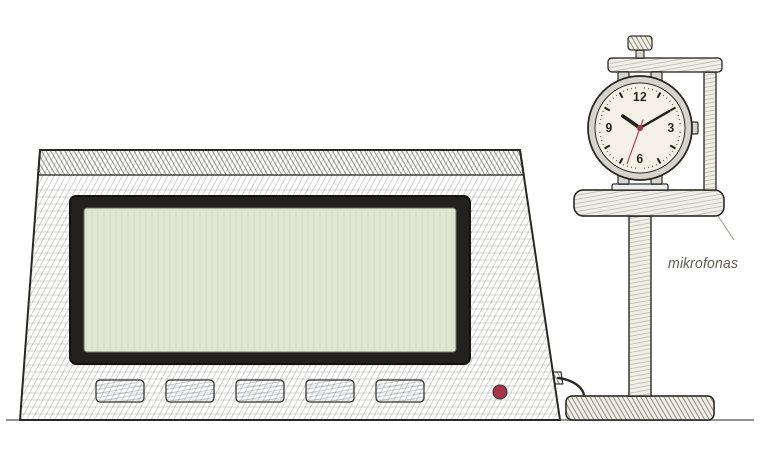
Fig. 6 · What amplitude tells
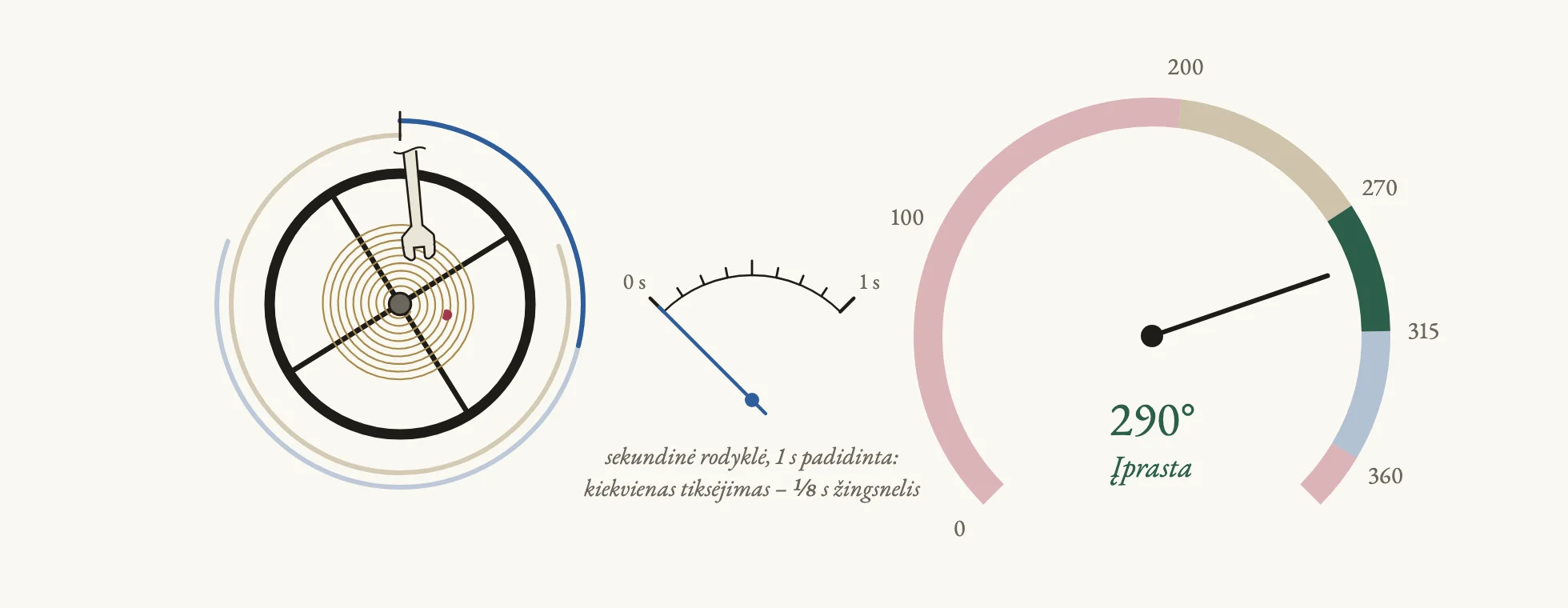
The limits are approximate and depend on the movement – the maker’s data are the most reliable guide. The sound is only an illustration.
- A timegrapher computes the amplitude from the movement’s lift angle. If it is set wrongly, the swing shown may be 10–20 % off. That is why two different watchmakers sometimes see different numbers. ↩
turns a day – that is how many the balance makes. And it never moves from its place.
Let us count: in every beat the balance turns about a turn and a half, and there are eight beats a second. 1.5 × 8 × 86,400 s = 1,036,800. Source: Balance wheel.
How it came about
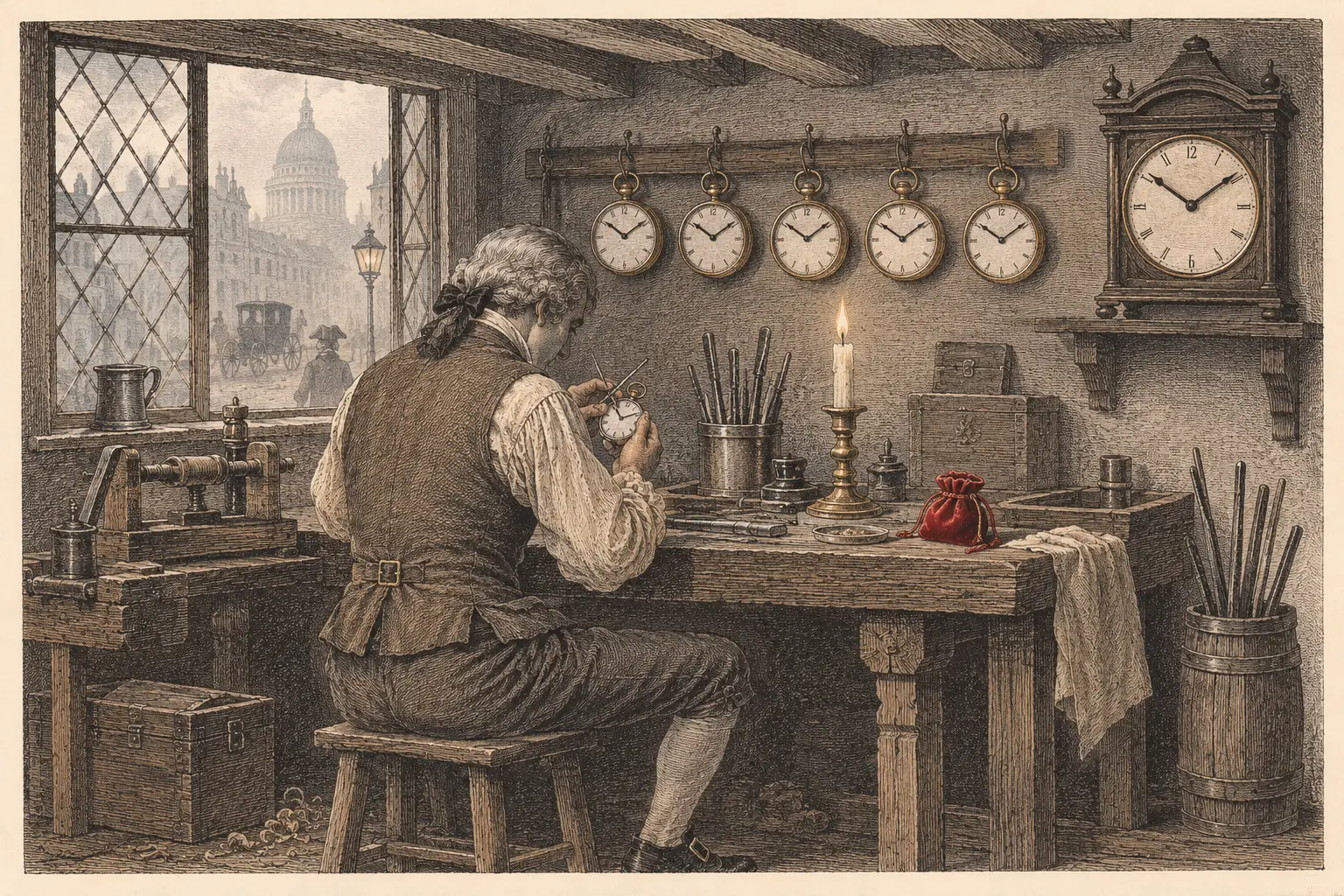
The lever escapement was invented by an Englishman, but it became the standard only around 1900 – almost a century and a half later. In that time more than one master improved it.
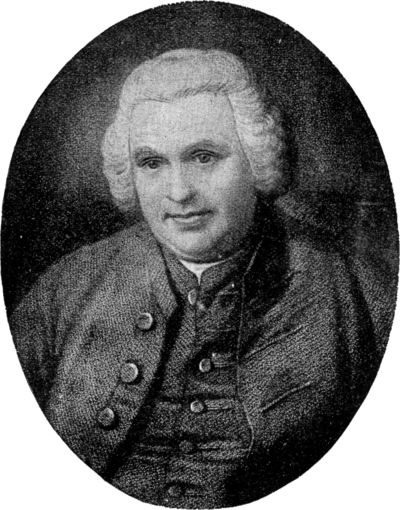
English watchmaker. Invented the lever escapement around 1754; it was first used in 1769.
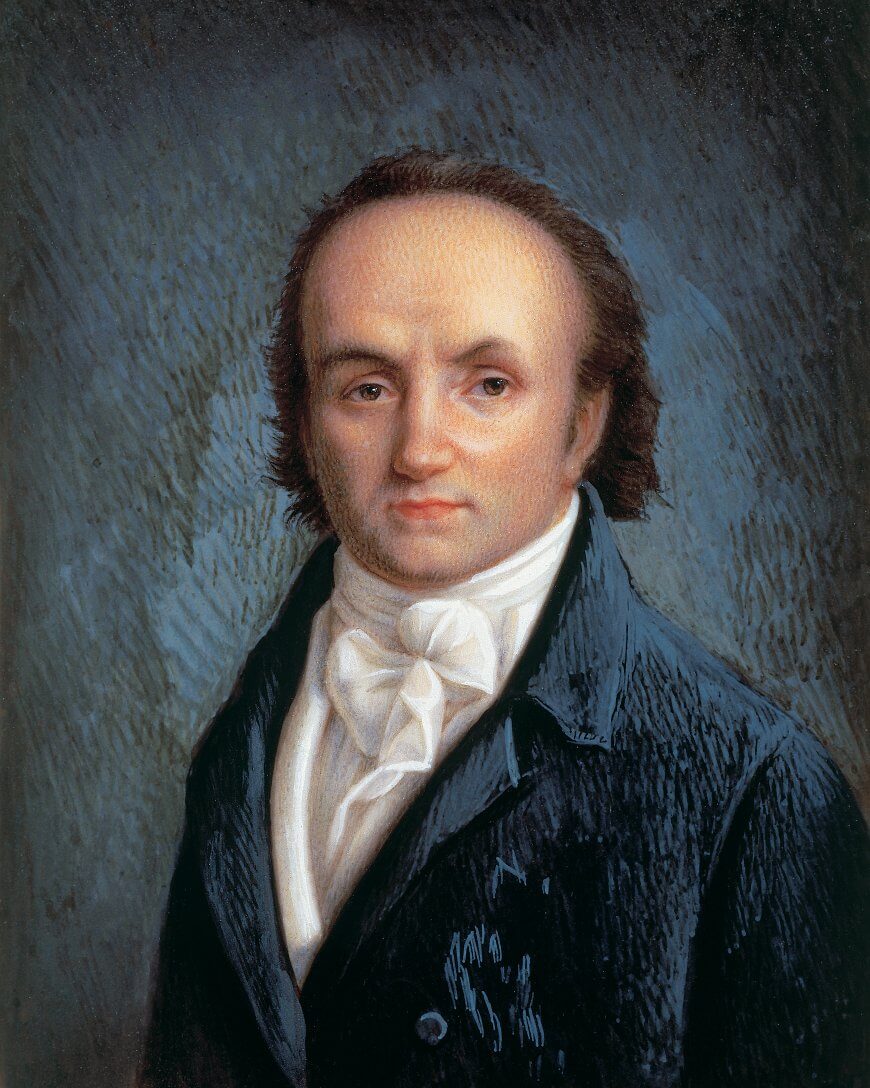
Improved the lever escapement in 1787.
- 1754Thomas Mudge invents the lever escapement in London.
- 1769First used in a watch.
- 1787Abraham-Louis Breguet improves it.
- 1791Peter Litherland proposes his own version.
- 1800Edward Massey contributes.
- early 19th c.George Savage creates the form still used today, with a separate impulse roller.
- ~1900The lever escapement becomes the standard: almost every mechanical watch, alarm clock and other portable timekeeper uses it.
In a day that is 691,200 beats, in a year more than 252 million. If your heart beats 70 times a minute, in the same year it contracts about 37 million times: the watch does its work almost seven times as often. And every time it stops – on the principle Thomas Mudge invented in 1754.
Sources
1. Lever escapement – Wikipedia: invention and improvement, phases of the escapement, draw (11–15°), the 15-tooth escape wheel, standard from ~1900.
2. Balance wheel – Wikipedia: a beat as one half-oscillation, frequencies (14,400–43,200), amplitude ~270°, the hairspring.
3. Mainspring – Wikipedia: an ordinary movement runs 36–40 h – 24 h between windings and 12–16 h in reserve.
4. Zenith (watchmaker) – Wikipedia: El Primero presented on 10 January 1969, 36,000 bph (5 Hz).
5. Grand Seiko history and calibre 9S85: 2009, 36,000 bph, ~55 h reserve.
6. GPHG: Jules Audemars avec échappement Audemars Piguet – 2009, 43,200 bph, 72 h, escapement presented in 2006.
7. Escapement – Wikipedia: working frequency 3–4 Hz, isochronism.
8. Collector Guide: Interpreting Timegrapher Results – Beyond the Dial (D. Flett, 2021): amplitude shows friction; below 200° – service needed; many Swiss movements above 300°, Seiko 21,600 above 250°; fully wound swings wider; lift angle: 50° for many ETA and Sellita movements, a wrong one gives a 10–20 % error.
9. Lift angle – Caliber Corner: the angle the balance turns while touching the lever; most often 48–54°.
10. How does the timegrapher measure amplitude – Watch Repair Talk (citing Witschi documentation): amplitude is computed from the time between the sound pulses of a beat, taking frequency and lift angle into account.
11. What Does it Mean When a Watch Needs “Rebanking”? – The Watch Doctor (2018): 270–315° is normal; too much – rebanking, the impulse jewel strikes the other side of the lever, “jumps”, gaining by hours.
12. Low Amplitude Issues after Servicing the Movement – AWCI: causes of low amplitude (magnetism, lubrication, wear, the mainspring, dirt).
13. Thomas Mudge (horologist) and Abraham-Louis Breguet – Wikipedia: years and places of birth and death.
The diagrams are simplified: proportions and angles of the parts are chosen for clarity, not taken from a specific calibre. Portraits are shown in one colour; the originals are behind the links.