
The magazine
About Horologist
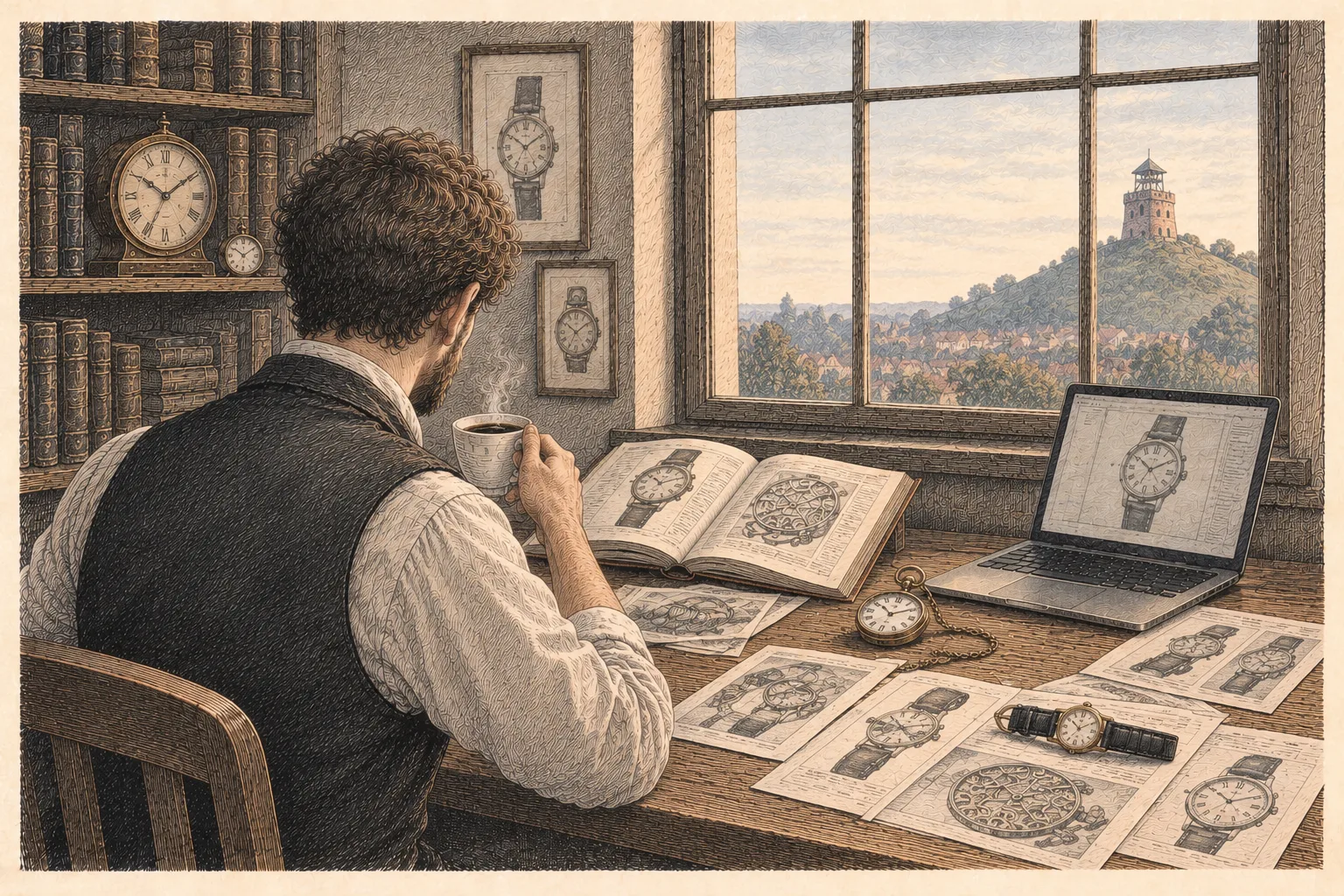
I wanted to make something cosy and pleasant, to read unhurriedly with the morning coffee. That is why the magazine looks a little old-fashioned: engravings, footnotes, calm classical typography.
But there is also a very modern side: in the article itself you can set the balance amplitude and watch the balance move 40 times slower, slide the year along a watch’s life, or tap an unfamiliar word and get an explanation from the glossary at once.
If you wear a mechanical watch, it is stopping right now. And moving again. And stopping again – most likely eight times a second. That is exactly why it shows the time. This is what Horologist writes about – an online magazine about mechanical watches, written in Lithuanian and translated into English and Russian. The first issue: .
Three sections
A technical detail up close: the escapement, the balance, the chronograph, automatic winding. Deep enough for an experienced collector to find something new, and clear enough for someone who bought their first watch last week.
People, watches with a story, the beauty of the craft. Why watches move us.
What is new, what sold at auction, what is happening in the market. Briefly, with links to the sources.
Articles on Thursday mornings, alternating “Techno” and “For the Soul”. News on Tuesday mornings.
- Techno No. 1
- Weekly news
- For the Soul No. 2
How an issue is made
- Topic. One idea or one object – and the question of what can be shown about it, not only told.
- Sources. I open and read the primary sources: makers’ archives, museum texts, auction house descriptions, press releases. Publications say what happened; the facts are taken from whoever publishes them first.
- Fact card. Before writing – a card: every fact with its source, and where sources disagree, that is written out separately.
- Text. Only what has been checked. No marketing words or clichés; what the sources do not know is said as such.
- Images. Photos at the highest resolution available, with author and licence. Diagrams follow the real construction of the mechanism. Engravings are AI-generated, always marked as such and checked so that they do not contradict the facts.
- Language. A native speaker reads the text, so that the Lithuanian is accurate and beautiful.
- Layout. Interactives, the glossary, the photo loupe. And a check of how the issue looks on a phone, in reader mode and to a screen reader.
How facts are checked
Every fact comes from a source I have opened and read. Under each article is a list of sources, and in the text the statement itself is often a link to the page it was taken from.
Below the sources, briefly, “How we checked”: which source is the main one, what it was checked against and where sources disagree. If one says 15 April and another 17 April, we do not pick the nicer date: we write what the main source confirms, or nothing at all.
The same goes for illustrations. If an engraving shows a real event, it must not contradict the facts: if a tree was cut down, it is not drawn uprooted.
How the magazine improves
Every remark becomes a rule for all issues, not only for the one where it was noticed. That is how the list of principles grew: from how diagrams are drawn and illustrations checked, to never cropping photos and giving every interactive a still image for reader mode.
Artificial intelligence is only a tool
Yes, artificial intelligence helps make Horologist: it helps find and organise material, prepare a draft, draw a diagram or an engraving. It is an auxiliary tool – and that is normal, just as it is normal for an author’s text to be typed on a keyboard or dictated rather than written with a quill.
The most valuable part is human: ideas, editing and fact-checking. Without understanding the subject you cannot create good content, so the last word always stays with a person.
Contact
Spotted a mistake or an inaccuracy, have a question or a suggestion? Write to the author: roman@horologist.lt. We will correct mistakes and note what was corrected.